
All IPs > Wireless Communication > OBSAI
The OBSAI (Open Base Station Architecture Initiative) category in our semiconductor IP catalog is dedicated to providing high-quality and efficient semiconductor components for wireless communication systems. OBSAI is an industry standard that offers a modular base station design aimed at simplifying the development and deployment of telecom networks. OBSAI semiconductor IPs are integral for manufacturers who focus on building scalable and adaptable communication systems that meet the ever-evolving needs of global connectivity.
In the realm of telecommunications, OBSAI provides a framework that ensures interoperability and compatibility across various base station components. The IPs designed under this standard are tailored to support a seamless integration of different elements such as control and transport modules, RF modules, and remote radio heads. This modularity is crucial for facilitating upgrades and enhancements without necessitating a complete redesign of existing systems. As a result, OBSAI semiconductor IPs are pivotal in reducing costs and improving the efficiency of wireless networks.
OBSAI IPs are widely employed in the development of cellular base stations, enabling faster data rates and more reliable connections. These IPs support multiple interfaces and communication protocols, providing flexibility and future-proofing for emerging technologies like 5G. With the capabilities to handle large amounts of data traffic, OBSAI semiconductor IPs empower service providers to offer enhanced mobile broadband experiences to their customers.
Furthermore, the use of OBSAI semiconductor IPs is not limited to cellular networks alone. They find applications in various wireless communication systems, including public safety networks, private communication systems, and backhaul solutions. By ensuring robust connectivity and high performance, these IPs contribute to the building of smarter, more connected infrastructures, laying the groundwork for next-generation communication technologies. Whether you’re developing new telecom solutions or updating existing infrastructure, OBSAI IPs provide the necessary tools to ensure efficiency and scalability in your wireless communication projects.


aiSim 5 stands as a cutting-edge simulation tool specifically crafted for the automotive sector, with a strong focus on validating ADAS and autonomous driving solutions. It distinguishes itself with an AI-powered digital twin creation capability, offering a meticulously optimized sensor simulation environment that guarantees reproducibility and determinism. The adaptable architecture of aiSim allows seamless integration with existing industry toolchains, significantly minimizing the need for costly real-world testing.\n\nOne of the key features of aiSim is its capability to simulate various challenging weather conditions, enhancing testing accuracy across diverse environments. This includes scenarios like snowstorms, heavy fog, and rain, with sensors simulated based on physics, offering changes in conditions in real-time. Its certification with ISO 26262 ASIL-D attests to its automotive-grade quality and reliability, providing a new standard for testing high-fidelity sensor data in varied operational design domains.\n\nThe flexibility of aiSim is further highlighted through its comprehensive SDKs and APIs, which facilitate smooth integration into various systems under test. Additionally, users can leverage its extensive 3D asset library to establish detailed, realistic testing environments. AI-based rendering technologies underpin aiSim's data simulation, achieving both high efficiency and accuracy, thereby enabling rapid and effective validation of advanced driver assistance and autonomous driving systems.

The EW6181 GPS and GNSS solution from EtherWhere is tailored for applications requiring high integration levels, offering licenses in RTL, gate-level netlist, or GDS formats. This highly adaptable IP can be ported across various technology nodes, provided an RF frontend is available. Designed to be one of the smallest and most power-efficient cores, it optimizes battery life significantly in devices such as tags and modules, making it ideal for challenging environments. The IP's strengths lie in its digital processing capabilities, utilizing cutting-edge DSP algorithms for precision and reliability in location tracking. With a digital footprint approximately 0.05mm² on a 5nm node, the EW6181 boasts a remarkably compact size, aiding in minimal component use and a streamlined Bill of Materials (BoM). Its stable firmware ensures accurate and reliable position fixations. In terms of implementation, this IP offers a combination of compact design and extreme power efficiency, providing substantial advantages in battery-operated environments. The EW6181 delivers critical support and upgrades, facilitating seamless high-reliability tracking for an array of applications demanding precise navigation.

The TW330 distortion correction IP is tailored for use in applications requiring dynamic image transformations, such as VR headsets and automotive HUDs. Utilizing GPU-powered technologies, it offers real-time coordinate transformations, distortion corrections, and other modifications up to a resolution of 16K x 16K in both RGB and YUV formats. This IP is crucial for enhancing visual accuracy and display adaptability across varied markets.

The RFicient chip is a cutting-edge technology designed to optimize power usage in IoT applications. This ultra-low-power receiver is ideal for environments requiring long-term battery operation, such as remote sensors in industrial IoT setups. With its efficient energy harvesting capabilities, the RFicient chip is pivotal in advancing sustainable technology solutions, reducing power consumption within the Internet of Things (IoT) framework.
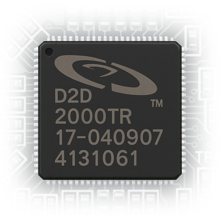
ParkerVision's Energy Sampling Technology is a state-of-the-art solution in RF receiver design. It focuses on achieving high sensitivity and dynamic range by implementing energy sampling techniques. This technology is critical for modern wireless communication systems, allowing devices to maintain optimal signal reception while consuming less power. Its advanced sampling methods enable superior performance in diverse applications, making it a preferred choice for enabling efficient wireless connectivity. The energy sampling technology is rooted in ParkerVision's expertise in matched filter concepts. By applying these concepts, the technology enhances the modulation flexibility of RF systems, thereby expanding its utility across a wide range of wireless devices. This capability not only supports devices in maintaining consistent connectivity but also extends their battery life due to its low energy requirements. Overall, ParkerVision's energy sampling technology is a testament to their innovative approach in RF solutions. It stands as an integral part of their portfolio, addressing the industry's demand for high-performance and energy-efficient wireless technology solutions.
Designed for smaller scale transformations, the TW220/240 IP handles tasks such as distortion correction, scaling, and rotation for images up to 4K x 4K resolution. It supports RGB and YUV formats, offering vital capabilities for applications needing precision in image processing at lower resolutions. Its applications span from consumer digital products to professional imaging equipment.
The Blazar Bandwidth Accelerator Engine brings in-memory computing directly to FPGA configurations. It provides a blend of high-capacity, low-latency memory aligned with extensive compute power to tackle bandwidth-intensive applications. With a throughput capacity of up to 640 Gbps and the potential for integration of up to 32 RISC cores, it supports high-performance applications such as SmartNIC and SmartSwitches. The device reduces data transport delays by implementing operations within the memory environment, significantly enhancing system responsiveness.

PhantomBlu by Blu Wireless is engineered for defense applications, focusing on delivering high-speed, secure, and reliable tactical communications. This mmWave networking solution is designed to be independent of conventional fibre optic or cabled networks, granting greater flexibility and range. With the capability to easily integrate with both legacy platforms and upcoming technological assets, PhantomBlu ensures interoperability and robust connectivity in demanding environments. The mmWave technology used in PhantomBlu allows for multi-gigabit data transmission over significant distances, catering to the dynamic needs of military operations. It can be configured to function as a PCP (hub) or STA (client), enhancing its adaptability in tactical scenarios. This flexibility is vital for mission-critical communications, ensuring data-rich, secure connections even in highly contested environments. By employing low Probability of Detection (LPD) and Low Probability of Interception (LPI) techniques, PhantomBlu provides stealthy communication capabilities, significantly reducing the risks of detection and interference by adversaries. This advanced technology strengthens the defense sector's communication arsenal, providing reliable gigabit connectivity that supports strategic and operational superiority on the battlefield.

The Cortus NB-IoT C200 targets Internet of Things applications that require low bandwidth and long battery life capabilities. Aimed at enhancing IoT connectivity, this NB-IoT solution integrates seamlessly with Bluetooth Low Energy, thus providing dual connectivity for complex IoT deployments. The NB-IoT C200 emphasizes energy efficiency, critical for IoT devices operating over extended periods without requiring frequent battery changes. This technology is suitable for applications such as smart metering, remote monitoring, and environmental sensing, where consistent low-rate data transmission is essential.

The Zmod SDR A sophisticated tool designed for software-defined radio (SDR) applications, combines high-performance processing with flexible, reconfigurable RF capabilities. Utilizing state-of-the-art FPGA technologies, this module supports complex signal processing tasks, adapting easily to various communication standards and protocols. It's an ideal solution for developers and researchers working on advanced wireless communication systems.
Designed for high-speed signal processing, the RFSoC-Module with AMD Zynq UltraScale+ ZU47DR-1E integrates RF data converters directly onto the Zynq platform. This integration simplifies the design of high-frequency applications, such as radar systems and wireless infrastructure, by reducing latency and improving signal integrity. It supports rapid prototyping and deployment in the field with its powerful processing and real-time capabilities.

The SpaceWire Node is engineered for critical communications in space networking environments. Integrating the AXI-Stream and SpaceWire interfaces, it facilitates robust data transfer speeds up to 200Mbps. The interface compliance with ECSS-E-ST-50-12C standards assures reliability and compatibility within the standardized space systems. Equipped with an internal management interface via AXI4-Lite, the SpaceWire Node can be efficiently controlled and monitored. The node's architecture is optimized for secure and efficient routing of space-borne data, aligning with the stringent reliability requirements of the aerospace sector. It comes with extensive features such as statistic registers for monitoring and performance evaluation, ensuring the node's abilities to meet rigorous performance benchmarks. Its design reflects an emphasis on interoperability and future scalability within complex space communications networks.

Join the world's most advanced semiconductor IP marketplace!
It's free, and you'll get all the tools you need to discover IP, meet vendors and manage your IP workflow!
No credit card or payment details required.
Join the world's most advanced AI-powered semiconductor IP marketplace!
It's free, and you'll get all the tools you need to advertise and discover semiconductor IP, keep up-to-date with the latest semiconductor news and more!
Plus we'll send you our free weekly report on the semiconductor industry and the latest IP launches!